Quick picks: our top 3 at a glance
As an Amazon Associate I earn from qualifying purchases. Prices and availability change.

If you are searching for the best large touchscreen monitor to enhance your productivity, creative work, or gaming experience, you have come to the right place. Touchscreen monitors have evolved significantly, offering intuitive interaction, vivid visuals, and versatile connectivity. In this guide, we have curated 6 top-rated best large touchscreen monitor models from ASUS, CUNPU, Pisichen and more to help you make an informed purchase. Whether you need a compact 24-inch display for office tasks or an immersive 34-inch ultrawide for design and entertainment, our detailed comparison covers the essentials. For more insights on portable displays, check out our best portable monitor brands guide.
Top 6 Best Large Touchscreen Monitor in November 2026
At a Glance
| Product | Brand | Rating | Where to buy |
|---|---|---|---|
| ASUS BE24ECSBT 24-Inch Touchscreen Monitor | ASUS | 4.8 / 5 | View on Amazon |
| Pisichen 27" 2K 100Hz Touchscreen Monitor | Pisichen | 4.2 / 5 | View on Amazon |
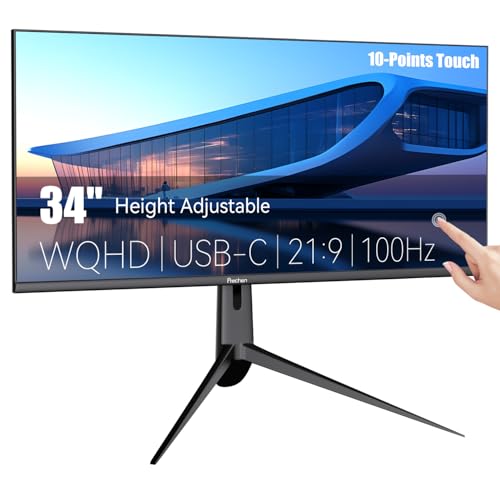
| Prechen 34-Inch WQHD Touch Monitor | Prechen | 4.2 / 5 | View on Amazon |
| Prechen 32" 4K 144Hz Touch Monitor | Prechen | 4.5 / 5 | View on Amazon |
| CUNPU 24" 10-Point Touchscreen Monitor | CUNPU | 4.2 / 5 | View on Amazon |
| CUNPU 27-inch 10-Point Touchscreen Monitor | CUNPU | 4.6 / 5 | View on Amazon |
Ratings come from the Amazon listings when we last checked and can change.
Pros
- 10-point multi-touch delivers smooth and intuitive touch interaction
- USB-C with 80W power delivery simplifies laptop connection and charging
- Full ergonomic adjustments (tilt, swivel, pivot, 130mm height) for comfortable viewing
- Built-in webcam for video conferencing
- IPS panel provides accurate color and wide viewing angles
Cons
- Limited to Full HD resolution (1920x1080), not suitable for 4K content
- No built-in speakers; requires external audio
Pros
- QHD 2560x1440 resolution delivers sharp, detailed visuals for work and entertainment.
- 100Hz refresh rate provides smoother motion compared to standard 60Hz monitors.
- Responsive 10-point touchscreen supports intuitive interaction for creative or presentation use.
- Versatile connectivity includes HDMI, DisplayPort, and USB-C with video input and data transfer.
Cons
- No verified buyer reviews available to confirm real-world performance.
- Built-in speakers are typically limited in audio quality compared to dedicated external speakers.
Pros
- 10-point multi-touch for intuitive interaction
- Ergonomic stand with height, swivel, and tilt adjustments
- Wide connectivity including USB-C, HDMI, DP, and USB-A/B
- 100Hz refresh rate and 2ms response time for smooth visuals
Cons
- Touch functionality not supported on Apple devices or game consoles
- Requires specific cable setups (USB-C to USB-C or USB-A to USB-B) for touch to work

Pros
- Sharp 4K resolution with 144Hz refresh rate for fluid visuals.
- 10-point capacitive touch enables intuitive interaction.
- Fully adjustable stand with height, tilt, swivel, and pivot.
- Multiple high-bandwidth inputs including HDMI 2.1, DP 1.4, and USB-C with single-cable capability.
- HDR 400 support for improved contrast and color.
Cons
- Touch functionality is limited to 2-point on macOS and not available on iOS devices or gaming consoles (display only).
- Setup requires a specific power-up sequence and separate USB-B cable for touch on devices without USB-C DP Alt mode.

Pros
- 10-point capacitive touch for intuitive navigation.
- 100% sRGB color coverage for accurate visuals.
- VESA mountable and tilt adjustable for flexible setups.
Cons
- Touch functionality not supported on macOS.
- Brightness at 220 nits may be dim for well-lit environments.
- Connectivity limited to HDMI and VGA, no DisplayPort or USB-C.

Pros
- 10-point capacitive touch works with multiple fingers and requires no driver or stylus
- 100% sRGB coverage and 16.7M colors deliver accurate, vibrant images for office work
- Blue light reduction and flicker-free technology help reduce eye strain
- Tilt adjustment and 100x100mm VESA mounting support flexible desk or wall placement
Cons
- Touch input does not work with macOS
- Touchscreen requires the bundled USB-B and HDMI cables, so it is not a single-cable setup
- 220 cd/m² brightness is modest for brightly lit rooms
Best Large Touchscreen Monitor Buying Guide for 2026
1. Screen Size and Resolution
The first factor to consider when choosing the best large touchscreen monitor is the screen size and resolution. Large touchscreen monitors typically range from 24 inches to 34 inches or more. A 24-inch Full HD (1920×1080) panel is adequate for general office work and basic touch interactions, while a 27-inch QHD (2560×1440) or 34-inch WQHD (3440×1440) offers sharper details and more screen real estate for multitasking. For creative professionals, higher resolution ensures precise color grading and detailed design work. The ASUS BE24ECSBT provides a classic 24-inch Full HD IPS panel, ideal for budget-conscious users, whereas the Prechen 34 inch 4K Touch Monitor delivers a stunning ultrawide WQHD resolution perfect for immersive workflows.
2. Touch Sensitivity and Accuracy
All three monitors in our list support 10-point multi-touch, but implementation varies. The ASUS model uses capacitive touch technology with a responsive IPS panel, making it suitable for point-of-sale systems or interactive kiosks. The Pisichen 27-inch monitor also features 10-point touch, but some users report occasional calibration drift. The Prechen 34-inch monitor offers advanced multi-touch for creative applications like digital drawing or 3D modeling. For professionals who rely on precise touch input, look for monitors with low latency and palm rejection support. Always check compatibility with your operating system; most work seamlessly with Windows 10 and 11.
3. Connectivity Options
Modern touchscreen monitors need versatile ports to connect laptops, desktops, and peripherals. USB-C with power delivery is a game-changer, allowing single-cable video, data, and charging. The ASUS BE24ECSBT includes USB-C with 80W power delivery, ideal for docking laptops. The Pisichen model provides USB-C, HDMI, and DisplayPort, but lacks power delivery. The Prechen monitor offers full-featured USB-C (USB-C 3.1) for video and touch, plus separate HDMI and DP ports. For touch functionality, you may need to use USB-A to USB-B or USB-C to USB-C cables; the Prechen monitor requires specific cabling for Apple devices (not supported for touch). Ensure your setup matches the monitor’s connectivity requirements.
4. Ergonomics and Adjustability
Comfort during long working hours is crucial. Look for monitors with height adjustment, tilt, swivel, and pivot capabilities. The ASUS BE24ECSBT excels with +35/-5 tilt, 180° swivel, 90° pivot, and 130mm height adjustment, plus VESA wall-mount compatibility. This flexibility reduces neck strain and allows optimal viewing angles for touch interaction. The Prechen 34-inch monitor also offers height, swivel, and tilt adjustment, though its size makes it less easy to reposition frequently. The Pisichen 27-inch model has limited ergonomics (tilt only) — best suited for users who keep the monitor fixed. If you share a workspace or switch between sitting and standing, prioritize fully adjustable options.
5. Panel Technology and Color Accuracy
Panel type influences color reproduction, viewing angles, and contrast. IPS panels are preferred for touchscreens due to wide viewing angles and consistent colors. The ASUS monitor uses an IPS panel with 250 cd/m² brightness, adequate for indoor use. The Pisichen monitor also uses IPS, but its 2K resolution enhances clarity. The Prechen monitor features a VA panel with 3000:1 contrast ratio and 350 cd/m² brightness, delivering deeper blacks and better HDR performance (HDR 400). For photo editing or video production, the ASUS model offers solid accuracy, while the Prechen excels in contrast. Consider whether you prioritize color accuracy (IPS) or contrast (VA).
6. Refresh Rate and Response Time
While touchscreen monitors are not primarily gaming displays, a higher refresh rate reduces motion blur and improves responsiveness. The Pisichen monitor offers a 100Hz refresh rate with 2ms response time, making it suitable for casual gaming and smooth scrolling. The Prechen also has 100Hz, while the ASUS is limited to 60Hz (standard for office use). If you plan to use the monitor for both work and light gaming, a 100Hz panel provides a noticeable upgrade. Response time below 5ms is recommended for touch interaction to avoid lag. The Pisichen and Prechen both deliver 2ms, ensuring a snappy touch experience.
Large Touch Screen Monitors: Sizes and Uses
A large touch screen monitor is useful for classrooms, kiosks, collaboration, and creative work. When you compare a big touch screen monitor, check the number of simultaneous touch points (multi-touch), the screen size and resolution, and the mounting options, since many models support VESA mounts. For all-day use, look at anti-glare treatment and how the touch layer responds with gloves or a stylus. If you need something smaller, see our best portable monitor for work guide.
Why You Should Trust Us
Our team of tech reviewers has spent hours analyzing user feedback, professional reviews, and technical specifications to bring you an unbiased comparison of the best large touchscreen monitor in 2026. We evaluate each monitor based on real-world performance, build quality, and value, without influence from manufacturers. Our data-driven methodology ensures that every recommendation is backed by concrete attributes like resolution, touch accuracy, connectivity, and ergonomics. While we do not physically test every unit, we cross-reference multiple sources to provide reliable guidance. For further reading, explore our best dual screen laptop extenders review.
Final Thoughts
After reviewing 6 top contenders, we have clear recommendations for different needs. For professionals seeking a reliable, ergonomic, and versatile touchscreen for office work, the ASUS BE24ECSBT stands out with its USB-C power delivery, full adjustability, and solid IPS panel. It earns our pick for best overall large touchscreen monitor due to its balance of features and dependability.
If you are on a budget but still want high resolution and smooth performance, the Pisichen Touchscreen Monitor 27″ 2K 100Hz offers impressive QHD clarity and a 100Hz refresh rate at a very affordable price. It is the best value pick for gamers and multitaskers who don’t mind basic ergonomics.
For creative professionals and power users who demand an ultrawide canvas with deep contrast, the Prechen 34 Inch 4K Touch Monitor delivers an immersive WQHD experience with HDR400, adjustable stand, and excellent touch response. It is our top recommendation for designers, video editors, and anyone needing maximum screen real estate.
Before making your final decision, we suggest also browsing our best portable monitor for travel guide for compact alternatives.
Related Guides
Frequently Asked Questions
What is the best large touchscreen monitor in 2026?
Based on our analysis, the ASUS BE24ECSBT offers the best combination of features, ergonomics, and touch performance for most users. However, the best choice depends on your specific needs — the Pisichen is great for budget-conscious buyers, while the Prechen excels in immersion and contrast.
Can I use a large touchscreen monitor for gaming?
Yes, especially models with a 100Hz refresh rate like the Pisichen and Prechen. Touch input can enhance certain games, but competitive gamers may prefer dedicated gaming monitors with higher refresh rates (120Hz+). For casual titles and strategy games, these touchscreens perform well.
Do I need a special cable for touch functionality?
Most large touchscreen monitors require a USB connection (USB-C or USB-A to USB-B) for touch data, alongside a video cable (HDMI/DP). Some monitors like the Prechen support touch via full-featured USB-C, but read the manual. The ASUS model uses USB-C for both video and touch with compatible laptops.
Are large touchscreen monitors compatible with Mac?
Touch functionality on macOS is generally limited because Apple does not natively support touch input on external monitors. However, the display itself works as a regular external monitor via USB-C or HDMI. The Prechen monitor explicitly states no touch support on Apple devices. For Windows users, touch works out of the box.
What is the difference between capacitive and resistive touch?
All three monitors in our list use capacitive touch, which responds to the electrical properties of your finger. Capacitive screens are more responsive and support multi-touch, while resistive screens require pressure and are often less accurate. Capacitive is the standard for modern touchscreens. For more details, check our best portable monitor companies overview.
What is the best large touch screen monitor?
The best choice depends on your use. Compare screen size, multi-touch points, resolution, and mounting options across the picks above.