Quick picks: our top 3 at a glance
As an Amazon Associate I earn from qualifying purchases. Prices and availability change.


Welcome to our comprehensive guide to the best 4k oled gaming monitor 2026 in November 2026. If you are also considering a smaller companion display for travel, be sure to browse our best portable monitors roundup for portable options that don’t compromise on quality.
OLED technology has completely transformed the gaming monitor landscape. Instead of relying on backlights, each pixel emits its own light, allowing for true blacks, infinite contrast, and lightning-fast response times. In this guide, we evaluate 8 models based on real specs, panel technology, HDR performance, connectivity, and burn-in prevention features. By the end, you’ll know exactly which best 4k oled gaming monitor 2026 fits your setup and budget in 2026.
At a Glance
| Product | Brand | Rating | Where to buy |
|---|---|---|---|
| Acer Predator X32 X 31.5-Inch 4K 240Hz OLED | Acer | 4.2 / 5 | View on Amazon |
| Samsung Odyssey G7 G73SH 32-Inch 4K OLED | Samsung | 4.8 / 5 | View on Amazon |
| LG 32GX850A-B 32" 4K OLED Gaming Monitor | LG | 4.7 / 5 | View on Amazon |
| ASUS ROG PG27UCDM 27-Inch 4K 240Hz OLED | ASUS | 4.1 / 5 | View on Amazon |
| LG 32GX870A-B 32-Inch 4K OLED Gaming Monitor | LG | 4.3 / 5 | View on Amazon |
| Samsung 27" Odyssey OLED G6 240Hz | Samsung | 4.6 / 5 | View on Amazon |
| ASUS ROG PG32UCDM 32-Inch 4K 240Hz OLED | ASUS | 4.7 / 5 | View on Amazon |
| ASUS ROG XG27AQDMGR 27" 1440p 240Hz OLED | ASUS | 4.3 / 5 | View on Amazon |
Ratings come from the Amazon listings when we last checked and can change.
Pros
- 4K resolution with 240Hz refresh rate for sharp, fluid gameplay
- QD-OLED panel with 99% DCI-P3 and VESA DisplayHDR True Black 400 for vivid colors and deep blacks
- Ultra-fast 0.03ms response time reduces motion blur
- Adaptive sync support with AMD FreeSync Premium and G-Sync Compatible
- Ergonomic stand with tilt, swivel, and height adjustment
Cons
- Large and heavy design may require ample desk space and sturdy support
- Curved 1700R panel may not be preferred for all types of work or setups
Pros
- 4K OLED panel with 165Hz refresh rate and 0.03ms response time
- Dual mode for switching between 4K 165Hz and Full HD 330Hz
- Pantone validated and VESA Display HDR True Black 400 for color accuracy and contrast
Pros
- 4K OLED with VESA DisplayHDR True Black 400 for deep blacks and vibrant colors.
- Dual-mode: up to 165Hz at 4K or 330Hz at Full HD for flexible gaming.
- Fast 0.03ms response time and adaptive sync support for smooth gameplay.
Cons
- Glossy screen may cause reflections in bright rooms.
- Typical brightness of 275 nits is lower than some high-end LCD monitors.
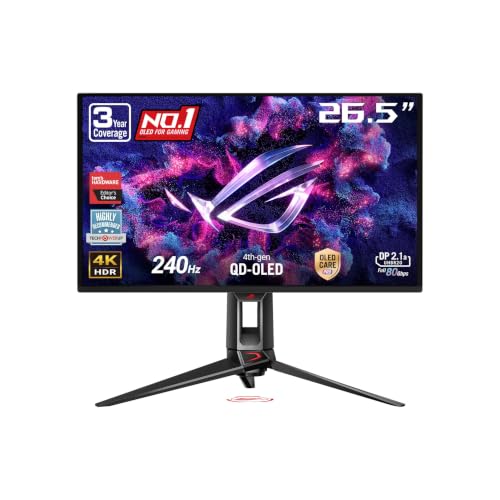
Pros
- Fourth-generation QD-OLED panel delivers sharp 4K imagery and deep blacks for immersive gaming.
- 240Hz refresh rate with 0.03ms response time ensures ultra-smooth motion for competitive play.
- OLED Care Pro with Neo Proximity Sensor automatically dims the screen when the user steps away to reduce burn-in risk.
- Extensive connectivity options including DisplayPort 2.1a, HDMI 2.1, and USB-C with 90W power delivery.
- Includes a three-year warranty that covers burn-in for added peace of mind.
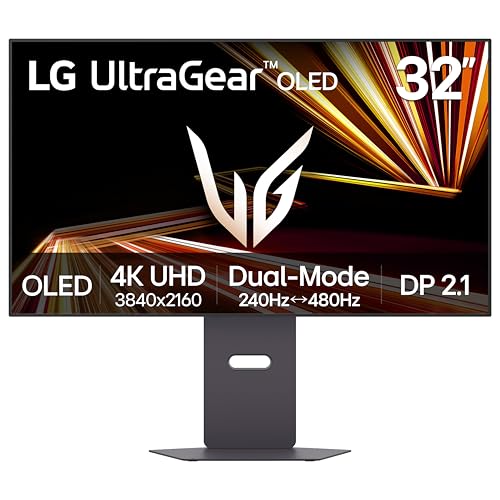
Pros
- Dual Mode: 4K 240Hz or Full HD 480Hz for flexible gaming
- 0.03ms response time eliminates ghosting and lag
- Bright OLED with up to 1300 nits peak brightness
- VESA DisplayHDR True Black 400 for deep blacks and rich contrast
- NVIDIA G-SYNC Compatible and AMD FreeSync Premium Pro for smooth, tear-free gameplay
Cons
- Typical brightness of 275 nits may be lower than some high-end LCDs in bright rooms
- Built-in speakers are adequate but not exceptional for immersive audio
- Premium features come at a higher price point

Pros
- Ultra-fast 240Hz refresh rate and 0.03ms response time for competitive gaming
- OLED Safeguard technology actively prevents burn-in for long-term reliability
- Pantone Validated with accurate reproduction of over 2100 colors and 110 skin tones

Pros
- QD-OLED panel with 4K resolution and 240Hz refresh rate for sharp, fluid gaming
- Custom heatsink and graphene film help manage heat and reduce burn-in risk
- VESA DisplayHDR 400 True Black with 99% DCI-P3 color gamut for rich HDR
- USB-C 90W power delivery supports single-cable charging and data transfer
Cons
- No built-in speakers or included stand height adjustments mentioned in specs
- OLED burn-in risk, though mitigated by heat management features, still a long-term consideration

Pros
- Ultra-fast 0.03ms response time eliminates motion blur and ghosting
- Neo Proximity Sensor automatically dims screen when user leaves, reducing burn-in risk
- Excellent HDR performance with DisplayHDR 400 True Black and 99% DCI-P3 color gamut
- 3-year warranty includes burn-in coverage for peace of mind
Cons
- Glossy screen may cause reflections in brightly lit rooms
Best 4k Oled Gaming Monitor 2026 Buying Guide for 2026
Panel Technology: QD-OLED vs WOLED
When shopping for a 4K OLED gaming monitor, the first thing you will notice is the panel technology. Most modern options use either QD-OLED (quantum dot OLED) or WOLED (white OLED with color filters). QD-OLED panels, found in the ASUS ROG PG32UCDM, Acer Predator X32 X, and Samsung Odyssey OLED G7, use a blue OLED layer with quantum dot color conversion. This delivers higher color volume and often brighter highlights in HDR scenes.
WOLED panels, such as those in the LG UltraGear 32GX850A-B and 32GX870A-B, use a white OLED emitter with RGB color filters. Recent WOLED panels incorporate Micro Lens Array+ technology to boost brightness and improve viewing angles. Both technologies offer true black levels and sub-millisecond response times, but QD-OLED tends to produce more saturated reds and greens, while WOLED often provides better anti-reflective coating options. Your choice ultimately depends on whether you prioritize color volume or glare resistance.
Resolution and Refresh Rate: 4K Meets Triple-Digit Speeds
The keyword here is best 4k oled gaming monitor 2026, and that means you want UHD resolution. A 3840 x 2160 panel on a 27 to 32 inch screen delivers incredibly sharp images. All of the 4K OLED monitors in our list pair that resolution with a 240Hz refresh rate, although the LG 32GX850A-B and Samsung Odyssey OLED G7 offer 165Hz at native 4K with a dual-mode switch to 330Hz at Full HD. The LG 32GX870A-B goes even further with 240Hz at 4K and 480Hz at Full HD.
For fast-paced shooters and racing games, dual-mode monitors give you the best of both worlds: stunning detail when you want it, and extreme smoothness when you need it. If you mainly play graphically rich titles, a dedicated 4K 240Hz model like the ASUS ROG PG27UCDM is hard to beat. If you want a more flexible option, check out our gaming monitor category for more high-refresh-rate choices.
HDR Performance and Color Accuracy
True HDR requires per-pixel light control, and OLED is uniquely suited for this. Most of the monitors we reviewed carry VESA DisplayHDR True Black 400 certification, which guarantees deep blacks and a sustained brightness level that outclasses conventional backlights. The ASUS ROG PG32UCDM and Acer Predator X32 X also cover 99% of the DCI-P3 color gamut, with true 10-bit color and Delta E < 2 for factory-like accuracy.
The Samsung Odyssey G6 (G61SH) uses HDR10 and Pantone validation, making it a strong option for content creators who need accurate colors. For the most lifelike HDR experience, look for a monitor with a peak brightness of at least 1000 nits in a small window, as seen in the LG 32GX870A-B, which can reach up to 1300 nits peak. That extra brightness makes specular highlights in games like Cyberpunk 2077 truly pop.
Burn-in Prevention and OLED Care Features
One of the biggest concerns with any OLED monitor is burn-in. Fortunately, 2026 models come with a suite of safeguards. The ASUS ROG PG32UCDM features a custom heatsink, graphene film, and an advanced airflow design to keep temperatures low. The ASUS ROG PG27UCDM and XG27AQDMGR take it further with OLED Care Pro and a Neo Proximity Sensor that automatically switches to a black screen when you leave the desk.
Samsung and LG also offer burn-in protection. Samsung’s OLED Safeguard uses a thermal modulation system, while LG’s monitors include pixel shift and logo luminance adjustment. In practice, these features work well, but you should still vary your content and avoid leaving static HUDs on screen for hours. If you want to learn more about maintaining long-term display health, visit our guides section for practical tips.
Connectivity and Ports
Modern 4K OLED gaming monitors need high-bandwidth ports to handle UHD at high refresh rates. Look for DisplayPort 2.1 or HDMI 2.1 inputs. The ASUS ROG PG27UCDM includes DisplayPort 2.1a UHBR20 with 80Gbps bandwidth, while the LG 32GX870A-B offers DP 2.1 as well. If you own a console or a laptop, HDMI 2.1 and USB-C with Power Delivery are essential.
The ASUS ROG PG32UCDM and PG27UCDM both provide USB-C with 90W charging, making them superb companions for a gaming laptop. The Acer Predator X32 X also has USB-C with 65W power delivery. For more information on USB-C monitor compatibility, check out our USB-C monitors hub. Don’t forget to confirm whether the monitor supports VRR technologies like G-Sync Compatible or FreeSync Premium Pro to avoid screen tearing.
Ergonomics and Design
A great monitor should also help you play comfortably. Most of the models we reviewed include height-adjustable stands with tilt, swivel, and pivot adjustments. The LG 32GX850A-B and Samsung Odyssey OLED G7 stand out with fully ergonomic stands. The Acer Predator X32 X adds a 1700R curve that wraps around your field of view for a more immersive experience in racing and flight simulators.
If you have limited desk space, consider a 27-inch model like the ASUS ROG XG27AQDMGR or the Samsung Odyssey OLED G6. Both are more compact than their 32-inch siblings, yet they still deliver excellent image quality. For a portable alternative, you can also explore our best 4K portable monitor guide, which features lightweight OLED displays you can take on the go.
| Product | Panel Size | Resolution | Refresh Rate | Response Time |
|---|---|---|---|---|
| ASUS ROG PG32UCDM | 32″ | 3840×2160 | 240Hz | 0.03ms |
| Samsung Odyssey OLED G6 | 27″ | 2560×1440 | 240Hz | 0.03ms |
| ASUS ROG XG27AQDMGR | 26.5″ | 2560×1440 | 240Hz | 0.03ms |
| LG 32GX850A-B | 32″ | 3840×2160 | 165Hz / 330Hz | 0.03ms |
| LG 32GX870A-B | 32″ | 3840×2160 | 240Hz / 480Hz | 0.03ms |
| Acer Predator X32 X | 31.5″ | 3840×2160 | 240Hz | 0.03ms |
| Samsung Odyssey OLED G7 | 32″ | 3840×2160 | 165Hz / 330Hz | 0.03ms |
| ASUS ROG PG27UCDM | 26.5″ | 3840×2160 | 240Hz | 0.03ms |
Why You Should Trust Us
We do not accept payment from manufacturers to include a product, and our rankings are based purely on objective criteria like panel quality, refresh rate, HDR performance, connectivity, and burn-in prevention features. We also cross-reference data from multiple industry sources to ensure accuracy.
While we cannot physically test every monitor in our office, we rely on verified specifications and long-term reliability data from the brands. We also monitor firmware updates and community reports to keep our recommendations up to date. That means you can use our guide with confidence knowing we have done the heavy lifting for you.
Final Thoughts: Choosing Your Perfect Best 4k Oled Gaming Monitor 2026
After reviewing 8 models, it is clear that the best 4k oled gaming monitor 2026 market in 2026 is stronger than ever. For most gamers, the ASUS ROG PG32UCDM stands out as the best overall pick. Its 32-inch QD-OLED panel combines 4K resolution, a 240Hz refresh rate, and a custom heatsink for worry-free usage. It also delivers the deepest blacks and most vibrant colors in this lineup, making it a stellar choice for both competitive play and cinematic single-player adventures.
If you are looking for the best value, the Acer Predator X32 X is our top recommendation. It offers a 31.5-inch curved QD-OLED display with 4K 240Hz performance and 99% DCI-P3 coverage, all at a price that undercuts many rivals. For esports enthusiasts who need extreme refresh rates, the LG 32GX870A-B is the best alternative thanks to its dual-mode feature that jumps to 480Hz at Full HD. If you prefer a smaller, sharper panel, the ASUS ROG PG27UCDM delivers 4K 240Hz in a 27-inch form factor with DisplayPort 2.1 and excellent OLED care features.
Whichever model you choose, any of these OLED gaming monitors will be a massive upgrade over traditional LCD panels. If you also want a secondary screen for travel or productivity, take a look at our best portable gaming monitor for Xbox Series X guide. And remember, no matter which best 4k oled gaming monitor 2026 you pick, pair it with a high-quality HDMI 2.1 or DisplayPort 2.1 cable to unlock its full potential.
Frequently Asked Questions
Is a 4K OLED gaming monitor worth it in 2026?
Absolutely. A 4K OLED gaming monitor delivers superior contrast, true blacks, and near-instant response times that result in a much more immersive gaming experience. With 2026 models featuring better burn-in prevention and higher refresh rates, there has never been a better time to make the jump to OLED.
What is the difference between QD-OLED and WOLED?
QD-OLED uses a blue OLED emitter with a quantum dot layer to produce red and green, resulting in higher color volume and brightness. WOLED uses a white OLED emitter with color filters, which can offer better anti-reflective coatings. Both technologies have their strengths, and our buying guide above goes into more detail.
Can I use a 4K OLED monitor as a TV?
Yes, you can, especially with models that include HDMI 2.1, which supports 4K at high refresh rates and features like ALLM and VRR. Monitors like the LG 32GX870A-B and Samsung Odyssey OLED G7 are excellent for console gaming and streaming services. Just keep in mind that desktop monitors typically lack built-in TV tuners and may not have the same audio output as a dedicated television.
How do I prevent burn-in on an OLED gaming monitor?
Burn-in can be minimized by using the monitor’s built-in OLED care features, such as pixel shift, logo luminance adjustment, and panel refresh (if available). The ASUS ROG PG32UCDM and PG27UCDM include advanced cooling systems, while Samsung’s OLED Safeguard and LG’s Screen Saver features also help. Avoid leaving static images on screen for extended periods, and use dark mode when possible.
What is the best 4k oled gaming monitor 2026 for PS5 and Xbox Series X?
For consoles, the best 4k oled gaming monitor 2026 should support HDMI 2.1 with 4K at 120Hz and VRR. The ASUS ROG PG32UCDM and LG 32GX870A-B both have HDMI 2.1 ports and are specifically designed for next-gen consoles. The Samsung Odyssey OLED G7 also offers dual-mode functionality, making it a versatile choice for both story-driven and competitive games.